AI Agent: What It Is and How SMEs Use It
Learn what an AI agent is, how it works, and where SMEs can use it for automation, workflows, and practical business tasks.
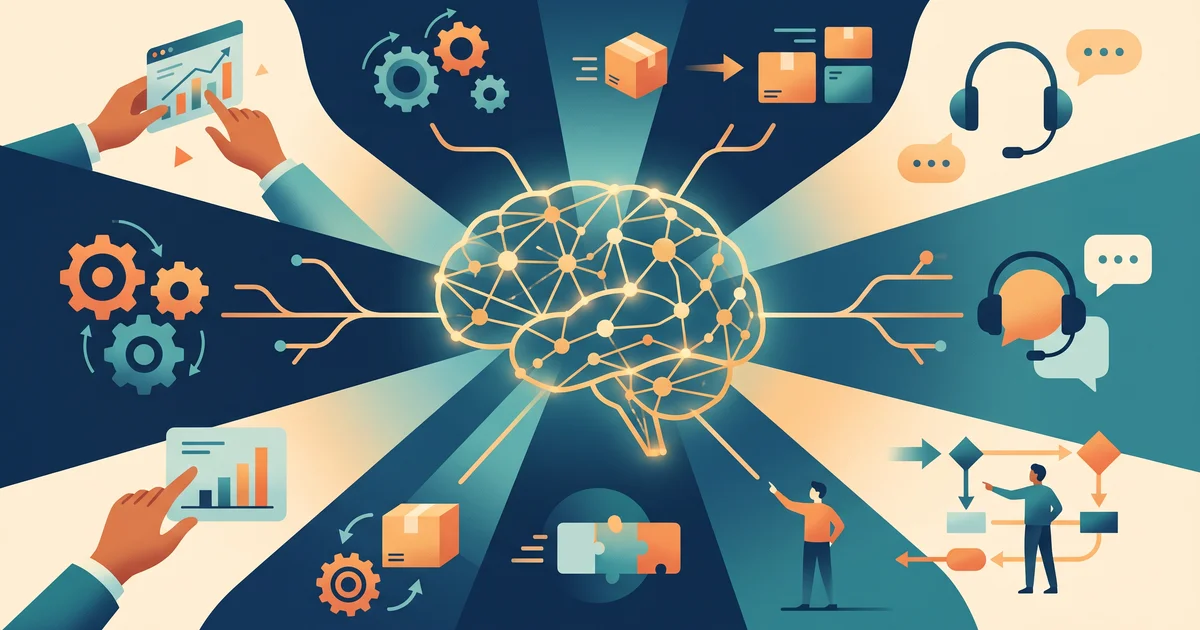
An AI agent is software that can take in information, make decisions, and perform multi-step tasks toward a goal with limited guidance. For small and midsize businesses, this often means turning tedious, repetitive work into more reliable and connected workflows that handle tools, escalate edge cases, and pass things to a human when needed.
What is an AI agent?
An AI agent is a system that can understand its environment, reason about what to do, and take actions toward a defined objective, even over a series of steps, not just in response to a single prompt. This is different from ordinary chatbots: an agent can use tools, retrieve information, follow instructions, and keep track of progress CrowdStrike’s overview of AI agents and Lenovo’s agentic AI guide. If a task needs a decision, uses external resources, or requires multiple steps, an AI agent may fit; if a single answer is enough, a typical chatbot is usually easier.
How does an AI agent work?
Most agents follow an action loop:
- Take a goal or request
- Break it into smaller problems
- Pull in relevant data or context
- Use tools or APIs to perform steps
- Check the results and decide what comes next
- Escalate, hand off, or finish when done
This reflects the architecture outlined by Lenovo, where planning, context retrieval, tool use, and evaluation are key.
How do you define an agent?
One simple way is to split it into two pieces:
- Definition: what the agent is meant to do, which tools it can use, what rules it follows
- Context: the information, documents, or data it can access while making decisions
ThoughtSpot describes the agent’s definition (its instructions, skills, tools) and its context (real-world information or app connections) as core ingredients ThoughtSpot's summary on building agents.
Where can SMEs use AI agents?
The biggest wins come from automating repeatable business tasks, especially across multiple systems. Common examples:
- Routing new leads to the right team based on form inputs
- Drafting first-pass replies using CRM data
- Checking or merging records across apps (CRM, email, spreadsheets)
- Cleaning and enriching incoming data before entering a pipeline
- Monitoring news or competitors for specific triggers
- Generating quick summaries or reports for meetings or follow-ups
If your team is lean and can’t afford delays with every manual handoff, agents shine in streamlining the process. SIÁN Agency works in these areas: automating websites, data cleanup, and connecting outside data to the tools teams already use SIÁN Agency home.
Invented example: a simple SME support agent
Invented example: A consulting firm gets a new inquiry. An AI agent classifies it, pulls company details from the CRM, drafts a reply, flags any missing data, and creates a follow-up task if needed. A human reviews and tweaks the reply before sending.
This isn’t about removing human judgment; it’s about stripping out repetitive work so staff can focus on decisions and relationships.
What does AI agent architecture look like?
A basic agent typically has these four layers:
- Interface layer: where requests enter (email, chat, forms, internal apps)
- Reasoning layer: interprets the goal and picks the next move
- Tool layer: where the agent acts, API calls, database checks, app triggers
- Control layer: handles logging, approval, retries, and security boundaries
Dividing these layers keeps decision logic separate from execution, which helps with reliability, oversight, and safety. The system always controls what the agent is allowed to do, not just what the model wants to try.
What should SMEs watch out for?
AI agents can save time but aren’t “set and forget.” The main risks are:
- Bad source data: messy inputs yield messy results
- Too many permissions: broad access increases risk if the agent goes off track
- Actions not logged: if processes aren’t transparent, errors go unnoticed
- No clear owner: if nobody is responsible, the process decays over time
- Security gaps: sensitive integrations demand tight access controls and reviews
CrowdStrike’s guidance is clear: secure the agent, its environment, and its data flows, not just the model itself CrowdStrike on agent security.
How do you pick the right AI agent platform?
Start with your workflow, not a trend. Ask:
- Does it connect to your existing tools?
- Can it log and explain its actions?
- Are permissions and security boundaries clear?
- Will a human review high-impact steps?
- Does it recover gracefully from errors?
- Can you tweak and maintain it as your business evolves?
Look for platforms and solutions that fit into your operational stack. SIÁN Agency, for example, focuses on integration-first automation, connecting sites, data, and AI to existing tools instead of replacing everything SIÁN Agency home.
What’s next for AI agents?
The trend: agents are getting more connected to business tools, tailored to specific roles, and better able to work together in small groups. Rather than a single assistant for everything, most teams are moving to deploy smaller, specialized agents focused on clear, recurring tasks, like lead routing, follow-up automation, or internal reporting.
If you want a hand picking the first workflow to automate, SIÁN Agency’s contact page can get you started with a discovery chat about your operations and what to automate next.
About SIÁN Team
SIÁN Agency builds automated data pipelines for small businesses — from web scraping to AI processing to workflow integration. We write about what we know from building these systems every day.
More Articles
Where Real-Estate Agencies Leak Time and Money (2026 Data)
What the research says about lost leads, slow replies and manual busywork in property agencies — and the five gaps worth closing first.
Data Pipeline for Small Business: The 2026 SME Guide
A practical 2026 data pipeline guide for small business — the 4 layers, real costs (€150–€800/mo), and the 380% first-year ROI math. No data engineer needed.
We Won the Apify 1 Million Challenge Grand Prize
SIÁN Agency took home 1st place in the Apify 1 Million Challenge. Here's what we built, how we approached it, and what it means for our work going forward.