AI Agents Use Cases for Business Teams
Practical AI agents use cases by department, with clear definitions, governance guardrails, and pilot ideas for SMEs and enterprise teams.
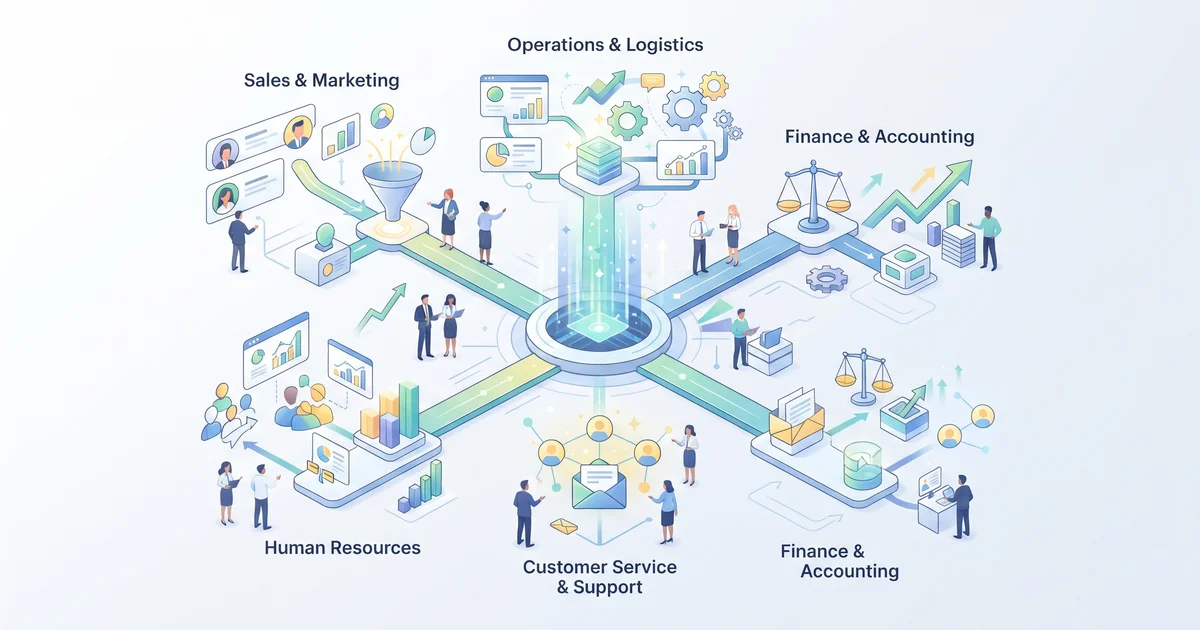
AI agents offer a smarter way to automate work that falls somewhere between chatbots and full-scale software rebuilds. This guide defines AI agents, explains how they differ from other tools, and breaks down practical use cases for support, sales, operations, finance, HR, procurement, and IT teams. You'll also find clear governance tips and pilot ideas tailored for small and midsize businesses (SMEs) and larger organizations.
What is an AI agent, and how is it different?
An AI agent is software that can pursue a goal by making decisions and using tools over several steps, not just answering one question at a time. This stands apart from a basic chatbot, which responds to prompts, or from traditional automation, which follows rigid instructions and can break when something varies.
Use an agent when your workflow changes often or demands a judgment call, like deciding which records to look up or which platform to access next. When the process is repetitive and predictable, standard automation will usually do the trick.
For a deeper explanation, see AI Agent: What It Is and How SMEs Use It.
Which business functions benefit most from AI agents?
AI agents shine in departments where requests arrive in mixed formats, decisions are repeated across multiple systems, or processes routinely jump between tools. Common spots include:
- Customer support and reception
- Sales and prospecting
- Operations/back office
- Finance
- HR and hiring
- Procurement
- Internal IT/helpdesk
You’ll often see agents triage inbound tickets, fetch context from different sources, handle exceptions, and draft responses or reports for later review. Many automation-ready teams start with a single workflow that has clear inputs, one owner, and a human signoff step.
If you're curious about front-desk bots, check AI Receptionist for Small Business in 2026 or How AI Receptionists Boost Customer Experience for SMEs.
Practical AI agent use cases, by function
Here’s a rundown of department-level examples you can map onto your stack.
Customer Support & Reception
- Classifies and routes incoming emails or tickets
- Gathers background on customers
- Drafts initial replies, routes urgent issues
- Automates receptionist tasks like lead qualification and appointment booking
This category is usually the easiest win: high volume, clear handoffs, and established escalation rules. For details, see the links above.
Sales & Lead Operations
- Researches targets and enriches CRM records
- Summarizes account activity for handoff
- Drafts follow-up emails and call briefs
- Prepares better data for outreach
Full autonomy isn’t the goal here, just faster prep, fewer errors, and quicker follow-ups.
Operations & Back Office
- Handles supplier and vendor updates
- Checks fields for missing information
- Builds internal checklists or flags data mismatches
- Routes exceptions to humans
This works best where requests are unpredictable enough to frustrate pure rule-based automation.
Finance & Accounting
- Takes in invoices, matches POs, and sorts expenses
- Flags exceptions for review
- Helps explain variances, but always keeps a human in the loop
Here, agents can save time on reconciliation, but shouldn’t push changes directly to accounting systems.
HR & Hiring
- Compares new applications to baseline criteria
- Helps summarize candidate details
- Books interviews
- Answers routine policy questions
- Prepares onboarding packets
Anything involving hiring or sensitive data should be carefully scoped, these agents support, not decide.
Procurement & Vendor Management
- Collects required vendor details
- Summarizes or compares quotes
- Flags missing documentation
- Prepares draft approval notes
The main goal is quicker reviews, not removing oversight.
IT & Internal Service Desk
- Triage for password resets or access requests
- Routes tickets to the right group
- Looks up relevant knowledge-base articles
- Offers standard troubleshooting tips
IT is often a good test bed, thanks to repeat issues and fixed escalation paths.
AI agent governance and security in the enterprise
As agents gain more autonomy, strong governance becomes essential. Treat agents as systems needing permission, logging, and review, not just clever bots.
Essentials include:
- Least-privilege access to tools and data
- Human approval for risky actions
- Audit logs tracking prompts, tool use, and outcomes
- Clear limits on what the agent can access
- Data minimization for sensitive information
- Vendor, platform, and integration vetting before launch
For a fuller approach, see Agentic AI Security Framework for SMEs, and best practices for third-party data in Ethical Web Scraping: Best Practices for 2026.
How can SMEs pilot an AI agent safely?
The best pilot is focused, measurable, and easy to roll back. Start with one workflow that already has a clear owner and a human approval step.
Pilot plan checklist:
- Pick a process that consumes manual hours weekly
- Specify the input, output, and handoff rules
- List every tool the agent touches
- Require human review for high-impact steps
- Measure cycle time, error rate, and handoff quality
- Only expand after the basics work reliably
Invented support triage pilot:
- Input: new support email
- Agent: classifies and extracts customer details, drafts a reply
- Human: approves before reply sends
- Win: time saved per ticket
Invented sales research pilot:
- Input: lead list
- Agent: enriches records, drafts context for outreach
- Human: reviews before sending
- Win: faster, more accurate prospecting
When you’re ready to scale up, SIÁN Agency can help design secure workflows and wiring. Book a strategic consultation to get started.
Where do AI agents fit in a mature automation stack?
AI agents work best as part of a layered system, not solo. Most teams surround agents with data capture, storage, notifications, and review flows.
Platforms like n8n make it easy to coordinate agents with structured pipelines, automations, and approvals. For more on automation stack design, explore:
- n8n Automation: A Practical Beginner Guide
- AI Agent: What It Is and How SMEs Use It
- n8n vs Make vs Zapier: What 10K Runs Cost in 2026
In short: lean on AI agents for work that takes judgment or changes often, and use standard automation where the steps seldom change. The best-run companies use both, each where it fits.
About SIÁN Team
SIÁN Agency builds automated data pipelines for small businesses — from web scraping to AI processing to workflow integration. We write about what we know from building these systems every day.
More Articles
Agentic AI Security Framework for SMEs
A practical agentic AI security framework for SMEs: risks, controls, and pipeline-ready steps for safer AI automation.
AI Receptionist for Small Business in 2026
Learn what an AI receptionist can do, how to set one up, and where it saves time for small teams with front-desk automation.
How AI Receptionists Boost Customer Experience for SMEs
See practical AI receptionist use cases, best practices, and integration tips SMEs can use to improve response speed and service.